Types of floor displays
- Free-standing shelf display – 3–5 shelves, the most common format in FMCG campaigns.
- Half-pallet (800×600 mm) and quarter-pallet (600×400 mm) displays – delivered with the product on the pallet and set up in store without repacking.
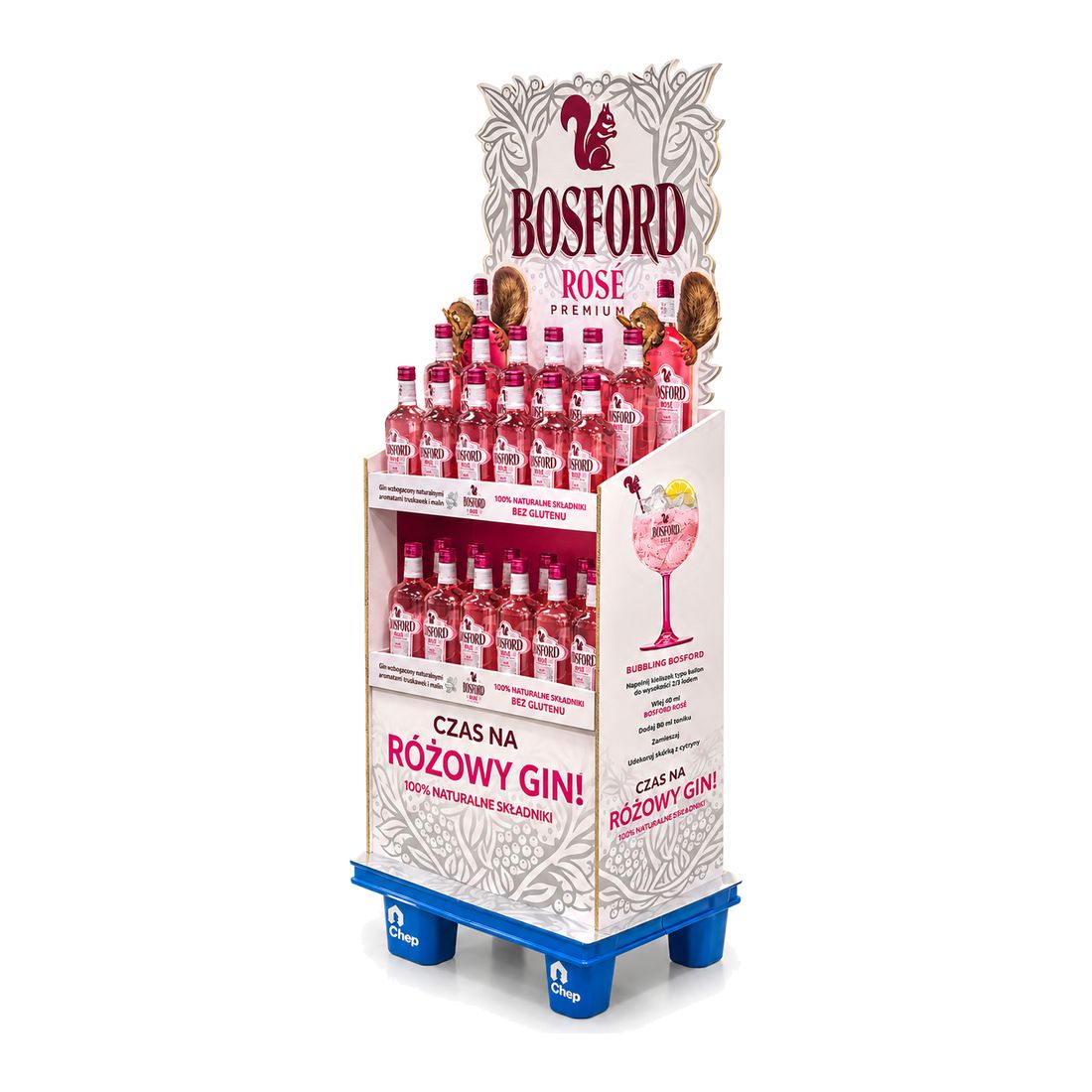
- Modular tray stand – trays stacked one on top of another, for heavier products; it can arrive at the store stocked with product as RTS.
- Dump bin – for products sold loose and for promotions.
- Totems and display walls – brand communication, launches, sampling.
- Hybrid display – cardboard with rigid board, plywood or metal elements where extra durability is needed.
Modular tray stands
A modular stand is made of trays stacked one on top of another on a common base. Each tray carries its own share of the product, so the structure handles weight well: drinks, jars, spirits or cosmetics in glass. We match the number and height of the trays to the product and the number of SKUs.
- Double-wall board – usually EB or BC flute, chosen for the product’s weight; we check the load capacity of each tray on a prototype with the product.
- Plinth and topper – the plinth raises and steadies the stand, while the topper carries the campaign message above the product.
- Pallet – the stand can sit on a half or quarter pallet, including pooled CHEP or LPR pallets; we fit the structure to the pallet’s dimensions and the way it is fixed.
- FSC-certified materials – on request, from suppliers who hold the certificate.
RTS – a stand that arrives stocked
RTS (ready to sell) is a stand that leaves the supplier already stocked and secured on a pallet. In store, it only needs to be put in place and the film removed – no assembly and no stacking of products by store staff or sales reps. In a campaign across hundreds of stores, every store gets the same complete stand.
We design an RTS structure for transport: the trays and packaging must hold the product on the way to the distribution centre and to the store, which we check on a prototype with the real product. Stocking and packing are done by a co-packer – we quote co-packing together with the production of the stand.
How we design the structure
We start with the product: pack dimensions, weight, number of facings and the planned quantity of stock on the display. On that basis we choose the type of board (e.g. B, C or BC flute), the shelf layout, reinforcements and folding method. Before production you get a 3D visualisation, followed by a physical prototype to test in the office or in store.
What we focus on
- Load capacity and stability – we calculate shelves for the real load with a safety margin, and the display must not tip over when products are taken out.
- Set-up time – “pop-up” structures and designs with a minimal number of parts cut in-store set-up to a few minutes.
- Logistics – flat packing, shipping carton dimensions, number of displays per pallet.
- Retailer requirements – maximum heights, footprint, labelling and placement rules.
- Recycling – we design displays so they can be taken apart and recycled as waste paper, with no components that are hard to separate.
Print technologies
For short runs and tests we use digital printing directly onto board or onto paper that is then laminated, with no cutting-die costs. For large runs – offset litho-lamination and die-cutting, which lowers the unit cost. We match the technology to the run size, deadline and the graphic quality required.
Common questions
How much product can a cardboard display hold?
It depends on the structure and the board. A typical corrugated shelf with the right reinforcements carries anywhere from a few kilograms to a dozen or more. We always calculate load capacity for the specific product and test it on the prototype.
What is the minimum run size?
We make even single units (prototypes, trade show displays) and short digital print runs. From a few hundred units upwards, we usually switch to offset.
Will the display arrive assembled?
As standard, we ship displays flat, which lowers transport costs. On request, they arrive assembled or as RTS – stocked at a co-packer and ready to set up in store.