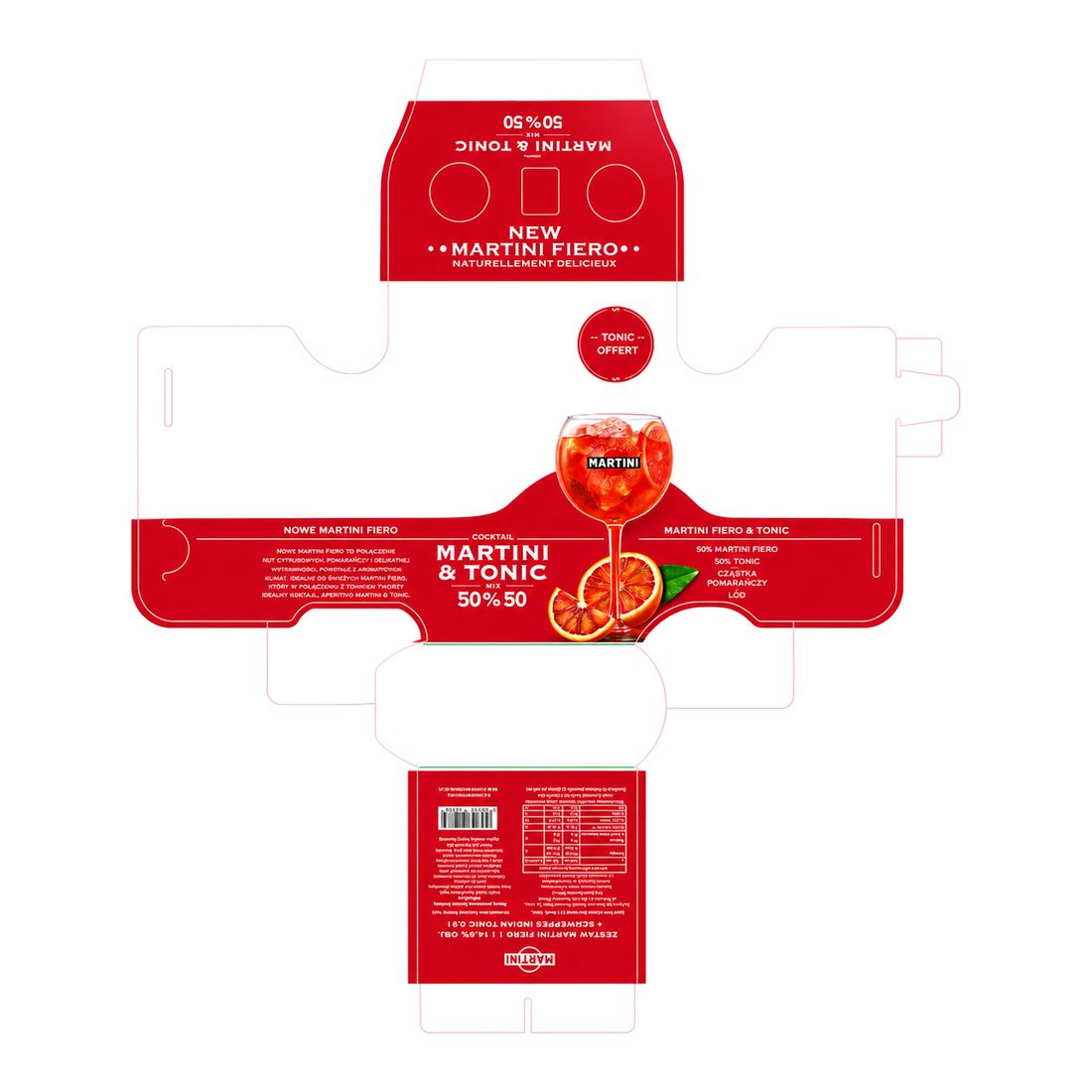
What prepress is
Prepress is the last step before the printer: turning the creative into a file that prints correctly on a specific press and a specific substrate. For POS materials and packaging it is much more than exporting a PDF – after printing, the sheet is still die-cut, creased and folded, so the artwork has to fit the die line, the creases and the glue areas.
In practice it covers:
- artwork on the die line – laying the creative out on the structure’s net: panels, glue flaps and areas that disappear or change direction once folded,
- bleed and safe zones – text, logos and codes kept away from cut and crease lines, backgrounds with bleed wherever the knife may shift,
- colour for the substrate and technology – CMYK and spot colours (Pantone), an ICC profile matched to the substrate and press (e.g. PSO Coated v3 for offset on coated paper, or the printer’s own profile for board), consistency with the brand’s colour standard,
- technical layers – die line, spot varnish, white underprint, lamination and embossing as separate colours and layers, labelled for the printer,
- technical checks (preflight) – image resolution, fonts, overprint, trapping, minimum line weights and type sizes,
- codes and mandatory text – EAN barcodes with the right contrast and quiet zone, ingredients, warnings (e.g. for alcohol), recycling marks and manufacturer details,
- language and market versions – one structure, several markets: text, codes and promotions in every version with no drift between files.
Why a POS print file is not just a PDF
After printing, a display or a pack is die-cut, creased and folded. Text on a crease cracks, the logo ends up on a glue flap and the product photo splits at the edge of a shelf. On brown corrugated board colours come out differently than on white paper, and without a white underprint the artwork on metallised film disappears. A file error only shows on the finished run – and then it costs a reprint of the whole series and a delayed campaign.
That is why we check every file on a 3D visualisation of the folded structure, and new structures also on a prototype that we build ourselves.
How we prepare the files
- Input materials – the creative (key visual) from the brand or agency, brand guidelines, the die line from us or from the supplier, and the printer’s specification.
- Artwork on the structure – we lay the creative out across the panels, move key elements off creases and glue areas, and scale it to the dimensions.
- Technical check – colour, resolution, fonts, overprint, bleed, codes and mandatory text.
- Approval – an approval PDF with the die line overlaid and a 3D visualisation of the folded piece; corrections from the brand and the agency in a single round.
- Production files – a PDF that meets the printer’s specification (usually PDF/X-4), die line and finishes on separate layers, each language version in its own file.
- Proof and colour – we compare the colour proof with the brand’s colour standard before the run starts.
Technologies and substrates
We prepare each file for a specific technology, because each has different requirements for colour, bleed and resolution: offset litho-lamination onto corrugated board, digital printing (short runs, prototypes, versioning), flexography for large runs of shipping cases and SRP, screen and UV printing on panels for permanent displays. Substrates: corrugated board with a white or brown liner, solid board, paper, PVC, PET and composite panels.
Language and market versions
The same structure often goes to several markets at once – in other languages, with different codes, prices and promotions. We prepare every version from a single source file, so the layout and colours stay the same and only the market elements change: text, mandatory copy, EAN codes, coupons and markings. It is part of brand deployment – the brand looks the same in every country.
What you get
- print-ready PDFs for every piece and every version, to the printer’s specification,
- die line and finishes on separate layers, labelled for the printer,
- an approval PDF and a 3D visualisation of the folded piece,
- open files (AI, INDD, PSD) – the design belongs to the brand.
Who it’s for
For brands and creative agencies that have the creative ready but need files for a specific structure, substrate and printer. Also as a standalone service – when you already have the structure and printing with your own suppliers, or want your finished files checked before they go to the printer.
Got the creative and need print files?
Send us the creative, the die line and the printer’s specification – we will come back with a quote and a timeline.
Email usCommon questions
How is prepress different from DTP?
DTP is layout and artwork preparation. Prepress is everything that makes the file print correctly on a specific press and substrate: colour, overprint, bleed, die line and finishing layers. For POS materials we do both together.
Can you prepare files from our agency’s creative?
Yes. We take the key visual and the brand guidelines, lay the artwork out on the structure and prepare the files for the printer. The agency gets an approval PDF and a 3D visualisation of the folded piece.
Can you prepare files for a printer we already work with?
Yes – to its specification: colour profile, bleed, file format and how the die line and finishes are marked.
Can you check finished files before printing?
Yes. We run a technical check of finished files: colour, bleed, fonts, overprint and fit to the die line. You get a list of comments or corrected files.