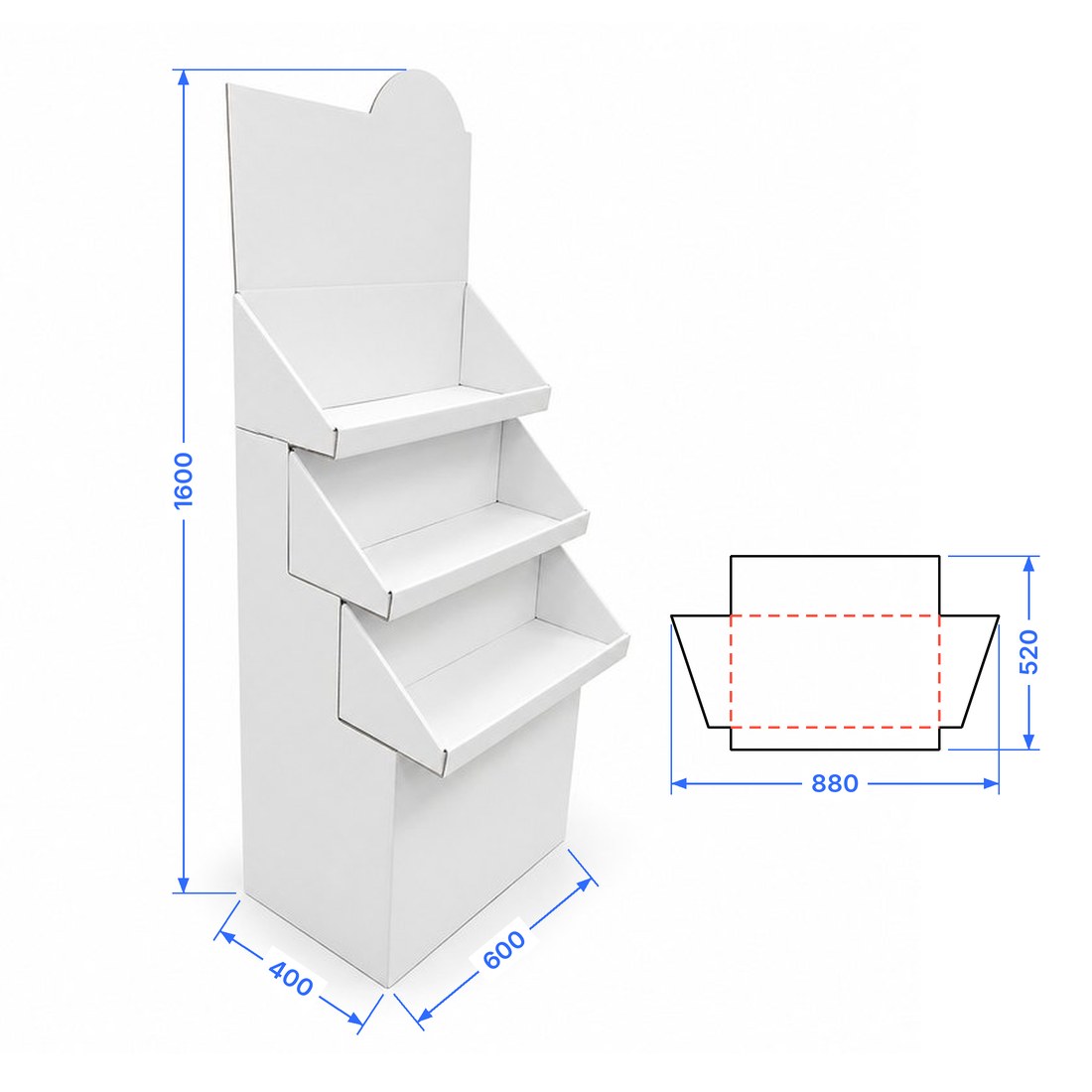
What reverse engineering a display involves
We take the display you have and rebuild its full production documentation from it. Usually it is a display made a few years ago or by another supplier: the brand has a unit in the warehouse and photos from stores, but no die lines, material specification or assembly instructions. Without documentation every order depends on one supplier, and other offers are hard to compare, because each supplier quotes a slightly different display.
What we rebuild
- dimensions and 3D model – we measure every part and build a 3D model of the assembled display,
- structure and die lines – every part laid out flat: cut lines, creases, perforations, flaps and glue areas,
- materials – board and flute type, grammages, liner colour and parts in other materials, e.g. plastic parts, hooks and strips,
- print and finishes – the printing technology, colours, varnishes and foils visible on the unit,
- assembly and packing – the assembly sequence, in-store assembly instructions, packing method, package dimensions and weight,
- load capacity – how much each shelf carries, checked with the product.
We check the rebuilt structure on a prototype we make ourselves from the new die lines. We compare it with the original before the documentation goes to suppliers.
A quote on one specification
With complete documentation, everyone quotes the same display – the same dimensions, materials, print and packing – so prices can be compared like for like. From us you get a production quote for several run sizes and lead times, and along the way you will see whether the price you pay today is in line with the market.
Optimisation: the same display, cheaper and simpler
Rebuilding the structure shows what costs the most in it. If you wish, we slim it down before it goes out for quotes:
- fewer parts and glue joints – parts combined into a single die line, interlocking tabs and clips instead of tape and glue,
- less material – a thinner flute where the load capacity allows it, and better nesting of parts on the sheet, meaning less waste,
- flat pack – less volume in transport and more units per pallet,
- faster in-store assembly – fewer steps, no tools, simpler instructions,
- easier recycling – a single material instead of cardboard combined with plastic, which makes it easier to meet the PPWR requirements.
We check every change on a prototype with the product: load capacity, stability and assembly time.
A new shape that follows the current one
Sometimes rebuilding alone is not enough – for example when you change suppliers and the rights to the current design are held by the previous supplier, or when the display needs a new look for the next campaign. Then we design a new shape. It keeps what works – the format, the way the product is presented, a recognisable silhouette and space for the brand’s message – but it is a new design. We show a 3D visualisation of the new shape next to the current one before the prototype is made. The new design belongs to the brand – the rights pass upon payment.
How we work
- The unit and whatever you have – send or bring the display, assembled or flat, and add photos from the store plus any old files, offers and specifications you have.
- Measurements and 3D model – we measure the parts and rebuild the structure.
- Verification prototype – we assemble the display from the new die lines and compare it with the original.
- Optimisation or a new shape – if you want to change the structure; we check every change on a prototype.
- Documentation – die lines, specification, assembly and packing instructions.
- Quote and production – a production quote on the same specification. We can manage production with a proven supplier, or you can hand the documentation to your own.
What you get
- a 3D model and visualisations of the assembled display,
- die lines for every part as vector files (PDF and DXF),
- a technical specification – materials, print, finishes, load capacity, packing and transport,
- assembly instructions for the store,
- a verification prototype – the display assembled from the new documentation and compared with the original,
- a production quote for several run sizes, if you need one.
The documentation belongs to the brand – the rights pass upon payment – so you can take it to any supplier.
When it helps
- changing supplier – documentation on which every supplier quotes the same thing,
- a reprint years later – the previous supplier no longer has the files or has left the market,
- a price check – your current price compared with our quote on the same specification,
- a new market – the same display produced locally in another country, as part of brand deployment,
- lower costs – a lighter and simpler structure, less material and transport,
- new artwork on a proven structure – we prepare the files as part of our DTP and prepress work.
A display with no documentation?
Send photos of the display and whatever documentation you have – we will come back with a quote and a timeline.
Email usCommon questions
Do you need a physical unit of the display?
Ideally yes – assembled or flat. If you don’t have one, we work with whatever is left: individual parts, photos with dimensions and old files. We rebuild the missing parts and check them on a prototype.
Can we send the documentation to another supplier?
Yes. The documentation belongs to the brand – the rights pass upon payment – so you can send it to any supplier. We can also quote and manage production ourselves.
What if the previous supplier holds the rights to the current design?
Then we design a new shape: a structure that does the same job in the store and follows the current display – in format, presentation and character – but is a new design. That design belongs to the brand.
How much does it cost and how long?
It depends on the number of parts and on whether the display is to be rebuilt 1:1, slimmed down or redesigned. From photos and a short description we will give you a quote and a timeline.